



sales@fwpcb.com
+852 21386086
1. Core Background: Not a Short-Term Shortage, but a Three-Way Structural Shock
The current CCL supply disruption should not be read as a normal inventory shortage. It is a structural shock created by three forces acting at the same time: a hard interruption in upstream raw materials, explosive demand from AI infrastructure, and a long-standing mismatch between high-end material capacity and end-market requirements.
In 2026, the global shortage in copper-clad laminate, or CCL, has two layers. The first is an acute supply shock in key upstream materials. According to the source analysis, SABIC's Jubail facility in Saudi Arabia, which represents a large share of global electronic-grade PPE/PPO resin capacity, entered force majeure after geopolitical disruption and industrial-park attacks, with no clear restart date. This directly constrains M8, M9, and M10 high-speed CCL production.
The second layer is a broader multi-material shortage across the chain. HVLP ultra-low-profile copper foil, low-Dk glass fabric, and specialized production equipment are all constrained at the same time. On the demand side, AI servers, 800G and 1.6T optical modules, and autonomous-driving platforms use far more high-speed CCL than traditional server platforms. Demand from Nvidia GB300/Rubin-class platforms and Google TPU deployments has pushed the high-end laminate gap into the millions of sheets per month, with the shortfall expected to widen further in the second half of the year.
CCL cost structure and supply-chain sensitivity

2. Three Upstream Bottlenecks: Raw Materials Are the Real Choke Point
The immediate constraint is not only CCL lamination capacity. It is the availability of high-end resin, copper foil, glass fabric, and the equipment needed to expand those materials. Any one of these can stop CCL production; in this cycle, several are tight at the same time.
2.1 High-end resin: the core trigger of the disruption
High-speed AI boards require low-loss PPE/PPO resin systems. Standard epoxy resin cannot meet the dielectric requirements of high-frequency, high-speed applications, especially where low Dk and low Df stability are required. The source article describes a concentrated supply structure in which most high-purity electronic-grade PPE is tied to a single Middle East production base, with the remaining capacity distributed among Japanese suppliers such as Mitsubishi and Asahi Kasei. New capacity takes more than three years to bring online.
The supply shock has been severe: spot prices reportedly moved from RMB 120,000 per metric ton to RMB 600,000 per metric ton, a 400% increase over four months. Lead times for top-tier M9 CCL expanded from around three weeks to about fifteen weeks. Global capacity for M8-and-above high-speed CCL was effectively reduced by 60%-70%, forcing many laminate and PCB suppliers to stop accepting new high-end AI board orders.
Substitution is limited. Hydrocarbon resin systems and PTFE can be used in some high-end applications, but they are much more expensive and require downstream customer qualification. In AI and high-speed-networking applications, material requalification can take six to twelve months, so substitutes cannot fill the gap quickly.
2.2 HVLP copper foil: a long-cycle structural shortage
For 1.6T optical modules and M9-class server boards, HVLP4 and HVLP5 ultra-low-profile copper foil are critical. High-speed signal integrity depends heavily on conductor surface roughness, so conventional copper foil cannot simply be swapped in without increasing insertion loss and degrading performance.
The source analysis states that Mitsui Mining & Smelting controls the overwhelming majority of high-end carrier copper foil supply. Global demand in 2027 is estimated at 40,000-50,000 metric tons, while overseas supply may be only about 15,000 metric tons, leaving a 30%-40% gap.
Expansion is slow. Electrolytic copper foil lines typically require 18-24 months to build, while precision control of surface roughness is a high-barrier manufacturing process. Qualification by PCB fabricators and server OEMs can take more than one year. Pricing pressure has already moved through the chain, with Mitsui reportedly raising prices by more than 50% in 2026 and domestic copper-foil producers following the trend.
2.3 High-end electronic glass fabric and core equipment
Low-CTE, low-Dk T-glass and NER glass fabric are essential for AI switches and advanced high-speed boards. The source article notes that Nittobo holds a dominant global share in these high-end fabrics, while meaningful new capacity may not be released until the end of 2027. Even conventional 7628 and 2116 electronic glass cloth has nearly doubled in price over roughly six months.
Production equipment is another constraint. High-end glass-weaving looms are supplied mainly by Toyota, with annual global availability of roughly 2,000 units against industry expansion demand of 6,000-7,000 units. Lead times for equipment are 18-24 months. With no immediate domestic equipment replacement available, glass-fabric expansion is directly capped, and the source article estimates that roughly 30% of CCL producers face some risk of production interruption.
3. Midstream CCL Capacity Is Structurally Misaligned
Mainland China has the largest total CCL capacity in the world, with a share of about 52%. The problem is mix, not total square meters. Low- and mid-end FR-4 capacity is ample, but high-speed, high-frequency CCL capacity for AI platforms is still scarce.
For ordinary consumer-electronics boards, domestic self-sufficiency is relatively strong. For M8/M9 high-frequency, high-speed AI laminates, however, the market is concentrated among Taiwanese producers such as Taiwan Union Technology, Taiwan Elite Material, and ITEQ, which together account for more than 60% of high-end global capacity. Mainland producers such as Shengyi Technology and Nanya New Material have only limited Nvidia-qualified capacity.
New high-speed CCL lines take a long time to become useful. From plant construction and process tuning to customer qualification, a full cycle can run 18-36 months. That makes it difficult to offset near-term demand gaps. Supply allocation has also shifted toward quota-based delivery. Leading CCL makers prioritize Nvidia, Google, and other strategic accounts, while smaller PCB and optical-module companies struggle to secure stable supply. Some downstream manufacturers have responded by over-ordering inventory, in some cases up to five times normal monthly demand, which further worsens the imbalance.
4. How the Shortage Moves Through the Supply Chain
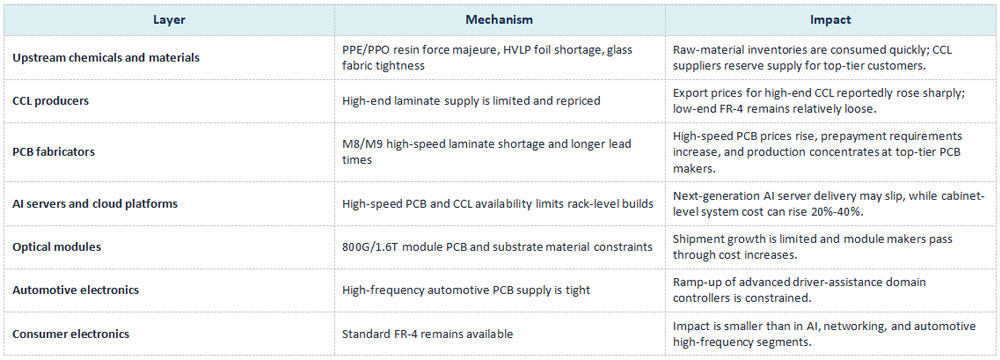
The impact is most severe downstream in high-speed PCB fabrication. The source article notes that M8/M9 high-speed PCBs saw monthly price increases of roughly 40%, the largest rise in a decade. Lead times extended, prepayment requirements moved above 50%, and payment terms shortened. Small and mid-sized PCB makers that cannot secure high-end CCL are forced to reduce output, while high-end AI PCB capacity concentrates further among leading suppliers.
For end markets, the pressure shows up as delayed AI server delivery, higher rack-level cost, constrained 800G/1.6T optical-module shipments, and slower ramp-up of high-frequency automotive electronics. Consumer electronics are less affected because standard FR-4 laminate supply remains relatively sufficient.
Transmission path and impact by supply-chain layer
5. Structural Root Causes Behind the Shortage
5.1 Single-point concentration and geopolitical fragility
High-end materials are highly dependent on specific regions and suppliers: PPE/PPO resin is tied to the Middle East, HVLP copper foil and high-end glass fabric are heavily dependent on Japan, and high-end CCL output is concentrated in Taiwan. Local geopolitical conflict, shipping disruption, or a plant accident can therefore become a global supply event because the chain has limited redundancy.
5.2 Technology barriers plus qualification barriers
Material formulation and precision manufacturing know-how have been accumulated overseas for decades. Even when domestic alternatives are technically developed, major AI customers such as Nvidia and Google typically require six to twelve months of material qualification and reliability validation. That means domestic substitution cannot immediately close an acute supply gap.
5.3 Capacity planning lagged behind AI demand
Before 2024, CCL capacity expansion was mainly anchored to smartphones and traditional servers. The industry underestimated the explosive material demand created by large-scale AI computing. Upstream chemical, copper-foil, and glass-fabric producers were cautious with capital expenditure, leaving expansion schedules far behind the demand curve.
6. Strategic Implications
The current CCL disruption is a structural, multi-year supply-chain crisis rather than a simple spot shortage. It requires coordinated industry action: supplier diversification, accelerated domestic material qualification, strategic buffer inventory for key resin/copper/glass inputs, and earlier joint planning among material suppliers, CCL producers, PCB fabricators, server OEMs, and cloud customers.
For PCB and electronics companies, the key management question is no longer only price. It is allocation certainty. Companies with secured high-speed CCL supply, qualified alternate material stacks, and strong customer-approved AVL positions will have a meaningful competitive advantage until the upstream bottlenecks ease.
Constraint type and likely time to resolution


Contact: Wing
Phone: +852 21386086
E-mail: sales@fwpcb.com
Whatsapp:+86 199 2764 2527
Add: Unit 3, 6/F., Kam Hon Industrial Building,8 Wang Kwun Road, Kowloon Bay, Hong Kong
We chat
