



sales@fwpcb.com
+852 21386086
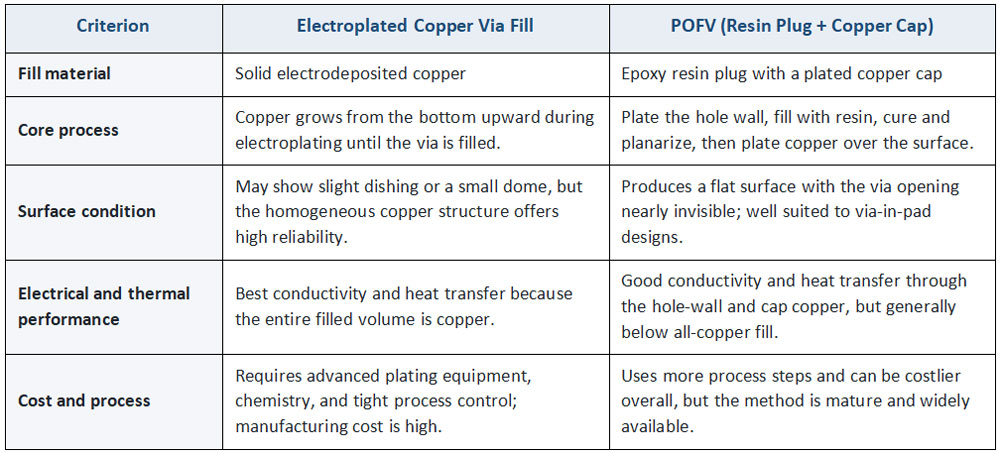
The correct choice depends on the design priority. All-copper electroplated fill maximizes electrical and thermal performance, while POFV delivers the flat, solderable pad surface required by many via-in-pad and fine-pitch BGA applications.
Fundamental Differences
How to Choose Between the Two Processes
Choose electroplated copper via fill when:
•Current-carrying capability and heat dissipation are the primary design drivers, as in high-current power modules and high-power equipment.
•The design uses complex stacked-via structures in servers or high-end HDI boards, where the interconnect must remain homogeneous and highly conductive.
•The available routing area is extremely limited and the design can justify the tighter plating-process controls required for reliable all-copper fill.
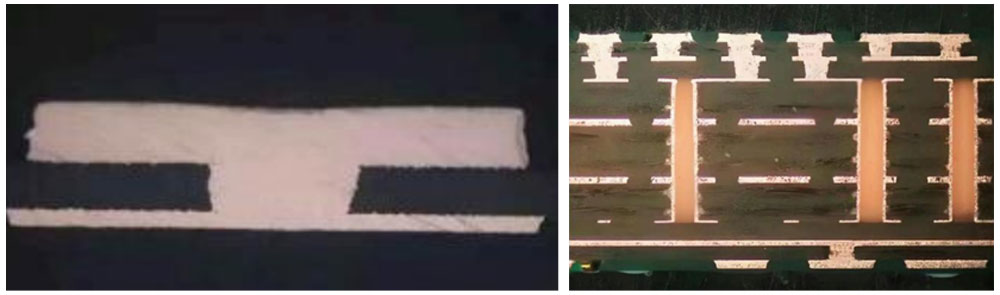
Why it works: The entire filled volume is copper, so there is no resin-to-copper material interface inside the interconnect. This provides the strongest electrical and thermal path when the plating process is well controlled.
Choose POFV when:
•The layout is very dense and the via must be placed directly in a component pad, especially beneath a fine-pitch BGA.
•Pad coplanarity and a flat solderable surface are more important than achieving the maximum possible thermal or electrical conductivity.
•The design uses larger plated through holes and provides sufficient spacing for resin plugging, curing, planarization, and copper capping.

Why it works: POFV is the most widely used approach for high-density via-in-pad construction because the filled and copper-capped surface is flat enough to support consistent solder paste printing and BGA attachment.
Avoid unnecessary mixed plugging schemes: To reduce cost, some designs specify resin plugging only for critical vias such as BGA via-in-pad features and use solder-mask plugging elsewhere. In practice, this mixed requirement can add special process routes, extend cycle time, and increase total cost. Unless the design has a strong reason to mix processes, using one plugging approach across the panel is usually more manufacturable.
Which Process Is More Reliable Beneath a BGA?
For plated through vias located directly beneath BGA lands, the source article recommends resin plugging followed by copper capping, namely POFV, as the more robust choice. Electroplated filling of blind microvias can offer superior electrical and thermal performance, but it is more sensitive to process variation and is generally reserved for advanced HDI designs with strong manufacturing controls.
Practical recommendation: For fine-pitch BGA via-in-pad, prioritize a flat and continuous land surface. POFV usually provides the most stable assembly result. Use electroplated blind-via fill when its performance advantage is required and the fabricator can demonstrate mature fill-plating capability.
Why BGA pad planarity is decisive
A BGA solder ball must attach to its corresponding land, so pad coplanarity is critical. POFV was developed specifically to eliminate the open cavity of a via-in-pad feature. The via is filled with resin, cured, planarized, and then covered with copper plating to create an extremely flat solderable surface.
This prevents solder from draining or wicking into the hole during reflow, which can otherwise reduce solder-joint volume, create voiding, cause missing or poorly formed joints, and compromise assembly yield. By contrast, electroplated blind-via fill may leave a small dimple or dome. On a fine-pitch BGA with very small lands, even slight nonplanarity can affect soldering quality and increase void risk.
Reliability risk assessment
POFV: interface and resin-control risks
The main POFV risks are the integrity of the resin-to-hole-wall copper interface and the adhesion between the planarized resin surface and the copper cap. Poorly controlled resin cure shrinkage, entrapped air, internal voids, or cracks can cause interfacial separation during thermal shock. With a mature plugging, curing, planarization, and plating process, however, these risks are controllable.
Electroplated blind-via fill: bottom-corner and void risks
The principal risk in electroplated blind-via fill is stress cracking near the via bottom and bottom corner. This region experiences the highest thermomechanical stress during thermal shock and is the most vulnerable point in a stacked-via structure. The process is also highly sensitive to internal voids and incomplete filling; either defect can interrupt the conductive path and cause an open circuit.
Qualification focus: Do not select either process by name alone. Review cross-section evidence, filling/plugging void criteria, cap-copper thickness, coplanarity data, thermal-stress results, and the fabricator's demonstrated production capability for the specific via geometry.
Decision Summary
•High current, heat transfer, and conductive stacked-via performance: favor electroplated copper via fill.
•Fine-pitch BGA via-in-pad, solderability, and pad coplanarity: favor POFV.
•When both options appear feasible, choose the process with the stronger demonstrated volume-production capability for the actual hole size, aspect ratio, stack-up, and reliability requirement.

Contact: Wing
Phone: +852 21386086
E-mail: sales@fwpcb.com
Whatsapp:+86 199 2764 2527
Add: Unit 3, 6/F., Kam Hon Industrial Building,8 Wang Kwun Road, Kowloon Bay, Hong Kong
We chat
